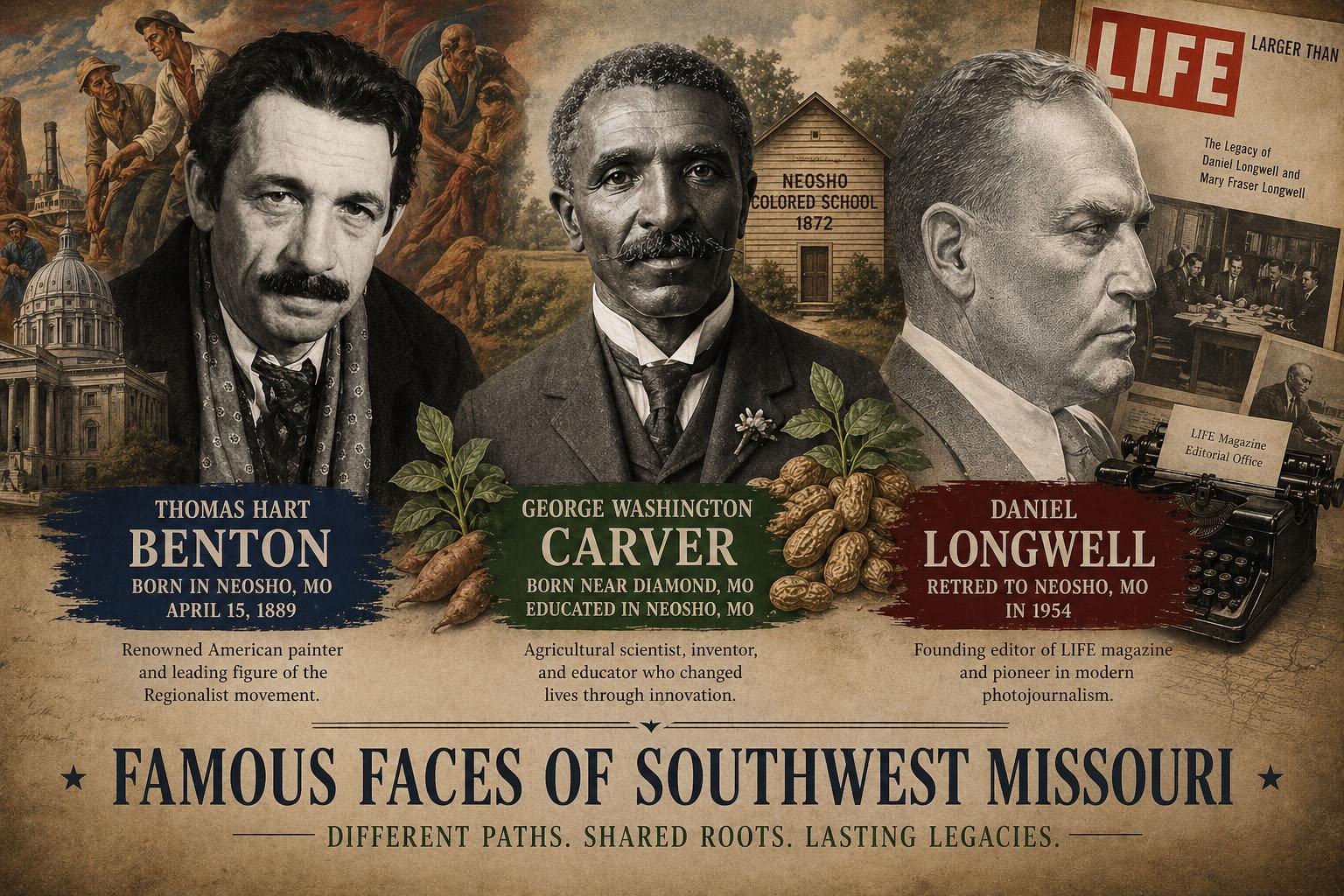
 Famous Faces of Neosho, MO & Southwest Missouri
Part 1: Lives That Began—and Came Back—Here
Southwest Missouri is known for its strong communities, deep roots, and enduring values. But beyond its small-town charm lies something even more meaningful—this region has helped shape individuals whose influence has reached across the nation and beyond.
At Clark Funeral Homes, serving Southwest Missouri since 1890, we believe every life tells a story worth remembering. Some stories stay close to home. Others travel far—but often, they begin right here.
In this first installment of our Famous Faces of Neosho and Southwest Missouri series, we highlight three remarkable individuals whose lives are closely tied to our region: Thomas Hart Benton, Daniel Longwell, and George Washington Carver. Each followed a different path—but all share a meaningful connection to Neosho and the surrounding area.
Thomas Hart Benton: Born in Neosho, April 15, 1889
Thomas Hart Benton, one of the most influential American artists of the 20th century, was born in Neosho, Missouri on April 15, 1889.
Raised in a politically prominent family—his father served as a U.S. Congressman—Benton spent part of his early life in Southwest Missouri before pursuing formal art training in Chicago and later in Paris. While his career would take him across the country and overseas, his Missouri upbringing left a lasting impression on the subjects and themes he would become known for.
Benton became a leading figure in the Regionalist movement, an artistic style that focused on everyday American life, particularly in rural and Midwestern communities. His murals and paintings captured scenes of farmers, laborers, and small-town life—depicting them with energy, dignity, and movement.
Works like America Today and his murals in the Missouri State Capitol reflect not just artistic talent, but a deep understanding of the American experience rooted in places like Neosho. His connection to this region helped shape his perspective, giving his work an authenticity that resonated nationwide.
Today, Benton’s legacy stands as a reminder that the culture and character of Southwest Missouri helped influence one of America’s greatest artists.
Daniel Longwell: A National Publishing Leader Who Chose Neosho
Daniel Longwell was born in Omaha, Nebraska in 1899, but his story has a meaningful and lasting connection to Neosho, Missouri.
Longwell became a key figure in American publishing as one of the founding editors of Life magazine. Under his leadership, Life helped pioneer modern photojournalism, combining powerful imagery with compelling storytelling in a way that transformed the magazine industry.
After a distinguished career with Time Inc., Longwell made a decision that brought him back to a quieter pace of life—he retired to Neosho in 1954, returning to a farm connected to his earlier life.
During his years in Neosho, Longwell became involved in the community and is often credited with helping promote civic pride and beautification efforts, contributing to Neosho’s identity as the “Flower Box City.”
He spent the remainder of his life here and passed away in Neosho in 1968, making the town not just a place of residence—but the place where his life came full circle.
Longwell’s story offers a different kind of connection to Southwest Missouri. While not born here, he chose Neosho as his home in later years—reminding us that sometimes, the places we return to matter just as much as the places where we begin.
George Washington Carver: A Life Shaped by Neosho Education
George Washington Carver was born in the early 1860s near Diamond, Missouri, just a few miles from Neosho. While his birthplace is often noted, one of the most important—and sometimes overlooked—parts of his early life happened in Neosho itself.
As a young boy with a strong desire to learn, Carver traveled to Neosho to attend school, enrolling in what was known as the Neosho Colored School, a one-room school established for African American students following the Civil War.
Around 1876–1877, Carver studied there while living with the Watkins family in Neosho. This period marked one of his first opportunities for formal education—an experience that helped ignite a lifelong passion for learning and discovery.
From those humble beginnings, Carver went on to become one of the most influential agricultural scientists in American history. At the Tuskegee Institute, he developed innovative farming methods, promoted crop rotation, and created hundreds of practical uses for crops like peanuts, sweet potatoes, and soybeans.
His work helped farmers improve soil health and sustainability, especially across the rural South. But at the heart of his achievements was a simple belief—that knowledge should be used to improve the lives of others.
Today, the George Washington Carver National Monument preserves the area where his life began, while the story of his education in Neosho stands as a powerful reminder of how opportunity can shape a future.
Different Paths, Shared Roots
- Thomas Hart Benton — Born in Neosho
- Daniel Longwell — Retired and spent his final years in Neosho
- George Washington Carver — Born nearby and educated in Neosho
Some were born here. Some were shaped here. And some chose to return.
Together, their stories reflect the broader story of this region—a place where determination is formed, creativity is nurtured, and lives take shape in ways that can reach far beyond local boundaries.
Honoring Every Life Story
At Clark Funeral Homes, we are reminded every day that every life has meaning. While not every story becomes widely known, each one leaves a lasting impact on family, friends, and community.
The individuals featured here achieved national recognition, but their journeys began in places familiar to us—on the same streets, in the same communities, and with the same values that continue to define Southwest Missouri today.
Looking Ahead
This is just the beginning of our Famous Faces of Neosho and Southwest Missouri series. In future installments, we’ll continue sharing the stories of individuals whose lives are connected to this region—each one contributing to the legacy we share.
Because here in Southwest Missouri, history isn’t just something we remember—it’s something we continue to build, one life at a time.